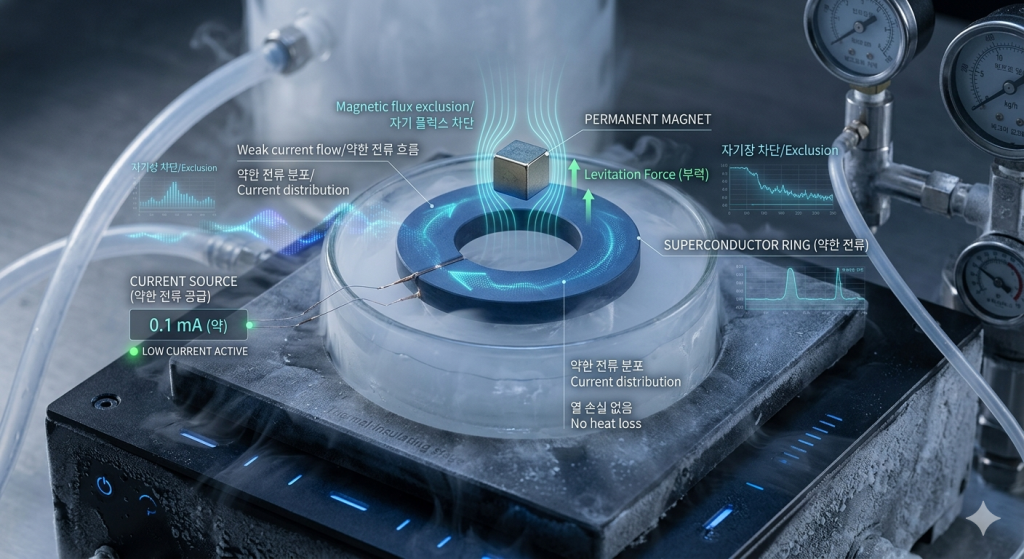

A Proposal for Discussion and Experimental Verification
For decades, the search for room-temperature superconductivity has largely followed a single paradigm:
Find the “right” material.
The global scientific effort has focused on discovering rare compounds, exotic crystal structures, or extreme pressure states capable of sustaining superconductivity at increasingly higher temperatures.
But what if the central problem has been framed incorrectly from the beginning?
What if superconductivity is not fundamentally a material discovery problem, but rather a phase-stability engineering problem?
That question is the foundation of the PBSH-X framework
(Phase-Buffer Synchronization Hybrid Structure).
⸻
1. The Core Hypothesis
The primary obstacle to room-temperature superconductivity may not be the absence of electron pairing itself, but rather the instability of large-scale quantum phase coherence under ambient conditions.
At room temperature, thermal fluctuations, lattice vibrations, magnetic perturbations, and electron scattering continuously destabilize collective quantum order.
PBSH-X proposes that:
A room-temperature superconducting-like state may be achievable if the system can dynamically counteract environmental decoherence through engineered internal phase reactions and weak-current synchronization.
The governing condition is proposed as:
\mathcal{F}_{buffer}+\mathcal{F}_{sync}(I_{weak})\geq\mathcal{F}_{noise}
Where:
- \mathcal{F}_{noise}: thermal, lattice, magnetic, and scattering-induced decoherence
- \mathcal{F}_{buffer}: internally engineered phase-buffer response
- \mathcal{F}_{sync}(I_{weak}): weak-current phase synchronization term
Instead of attempting to create a perfectly isolated superconducting material, PBSH-X attempts to maintain a dynamically stabilized coherent state.
⸻
2. Why Weak Current?
The inspiration comes from biology.
The human heart does not require massive electrical power to maintain synchronized mechanical behavior.
Instead, tiny millivolt-scale electrical pulses coordinate billions of cardiac cells into a coherent rhythmic system.
PBSH-X proposes a similar principle for quantum phase stability:
Weak current is not treated as a brute-force energy source, but as a phase-locking synchronization signal.
Synchronization term:
I_{pulse}(t)=I_0\sin(\omega t)
or
\mathcal{F}_{sync}(t)=\gamma I_{pulse}(t)e^{i\theta}
The objective is not to force superconductivity externally, but to stabilize collective phase coherence already near a critical threshold.
⸻
3. From Monolithic Materials to Hybrid Structures
PBSH-X does not assume that a single perfect material must exist.
Instead, it proposes that room-temperature superconducting behavior may emerge from a hybrid multilayer structure, where different layers perform different thermodynamic and quantum functions.
Proposed architecture:
+——————————————————-+
| Weak-Current Synchronization Layer |
+——————————————————-+
| Active Counter-Action Layer |
+——————————————————-+
| Phase Buffer Layer |
+——————————————————-+
| Quantum Coherence Core Layer |
+——————————————————-+
Each layer contributes to stabilizing macro-scale phase coherence.
This transforms superconductivity from:
a passive material property
into:
an actively managed phase-stability system.
⸻
4. Engineering Rather Than Discovery
PBSH-X does not require unknown exotic matter.
Instead, it suggests reinterpreting existing materials engineering through a new optimization objective:
- alloy engineering
- controlled doping
- multilayer thin films
- metamaterials
- crystallographic alignment
- thermal annealing
- resonance conditioning
- Josephson-type phase coupling
The key idea is:
The future of superconductivity may depend less on discovering rare materials, and more on programming phase behavior inside existing structures.
⸻
5. Potential Applications
If partially validated, even before achieving perfect room-temperature superconductivity, PBSH-X could potentially lead to:
- ultra-low-loss conductive structures
- weak-current-assisted magnetic levitation
- low-power transport platforms
- phase-stabilized energy systems
- high-efficiency electromagnetic systems
Importantly, PBSH-X does not initially target “perfect superconductors,” but rather:
metastable, phase-assisted, low-loss quantum structures.
This lower threshold may significantly improve experimental accessibility.
⸻
6. Why This Framework May Be Worth Investigating
The scientific value of PBSH-X is not that it claims superconductivity has already been solved.
It has not.
Rather, PBSH-X proposes a different organizing principle:
The central challenge of superconductivity may no longer be material discovery alone, but active phase-stability engineering.
If this perspective is even partially correct, it could open a new experimental direction connecting:
- condensed matter physics
- metamaterials
- synchronization dynamics
- phase-locking systems
- quantum coherence engineering
⸻
7. Final Statement
Nature may not require a perfectly isolated superconducting material.
It may only require a sufficiently synchronized quantum structure.
PBSH-X is proposed as an open theoretical framework intended for discussion, criticism, simulation, and experimental testing by the broader scientific community.
Intellectual Origin Notice
The PBSH-X framework, including its conceptual architecture, terminology, synchronization-based phase stabilization approach, and hybrid structural interpretation, was originally proposed by the author.
Readers, researchers, and institutions are encouraged to discuss, critique, simulate, and experimentally investigate the framework. However, any direct reuse, republication, commercialization, or derivative work based substantially on the PBSH-X concept should properly acknowledge the original source and authorship.
Scientific progress benefits from open collaboration, but intellectual contribution and conceptual origin should be ethically respected.